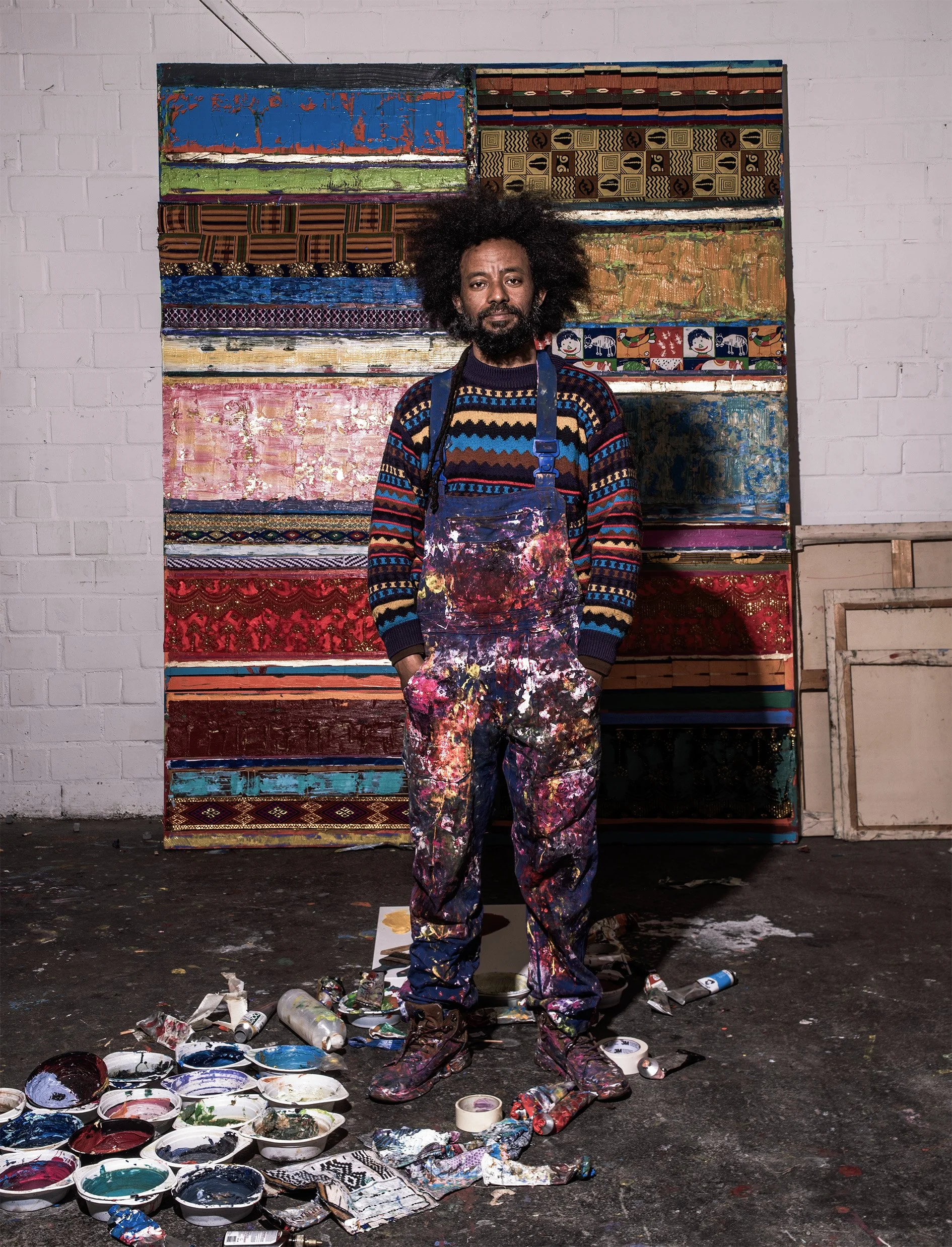
TEGENE KUNBI
Ethiopian artist Tegene Kunbi, born in 1980 in Addis Ababa, completed his studies in 2004 with a degree in Painting and Art Education from the Fine Arts School at Addis Ababa University. Following his graduation, he served as a lecturer at Kotebe College of Teacher Education.
In 2008, he was awarded the prestigious DAAD scholarship, which enabled him to leave Ethiopia and continue his studies in Germany at the Universität der Künste Berlin. There he pursued a Master of Fine Arts, which he obtained in 2011.
Since then, Kunbi has been living and working between Addis Ababa and Berlin.
The Artist gained international recognition after receiving the Grand Prix Léopold Sédar Senghor, the main prize of the Dak’Art Biennale 2022 – one of the most significant platforms for contemporary African art. The award was presented to him by Macky Sall, President of the Republic of Senegal, during the opening ceremony of the 14th Biennial of Contemporary African Art in Dakar.
Tegene Kunbi has participated in numerous international solo and group exhibitions, presenting his signature abstract works in a variety of contexts, including collaborative international projects and workshops. His work has been exhibited in cities such as Milan, Paris, New York, Berlin, Amsterdam, Tokyo, Nagoya, Accra, Dakar and many others.
Tegene Kunbi - Dale Grant Photography, © Dale Grant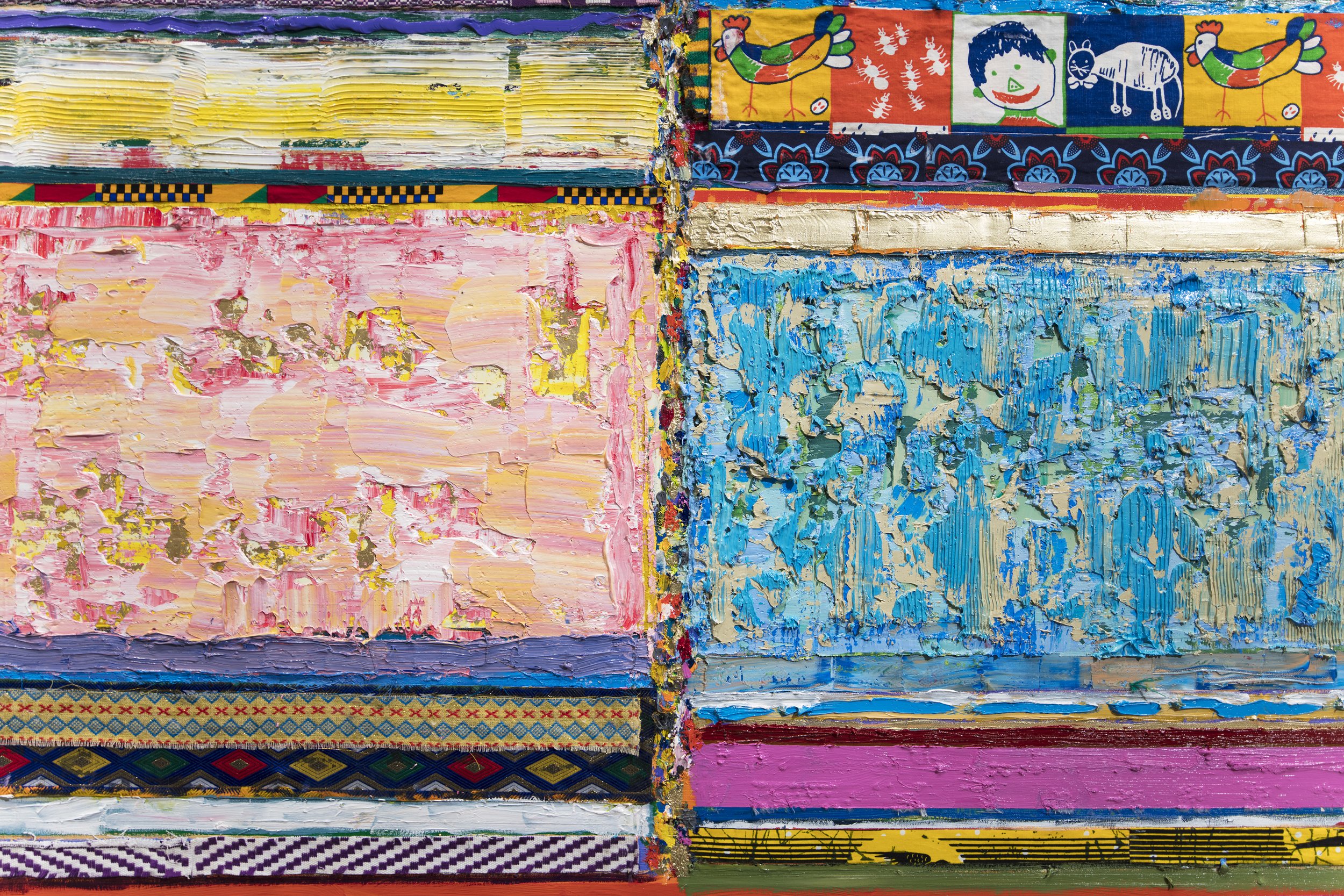
THE ARTIST’S PRACTICE
Tegene’s paintings are structured through a persistent yet dynamic geometric framework, within which dense fields of color are built up through repeated layering. His process involves the accumulation of oil paint, pastel, and textiles, applied with palette knives, brushes, and the artist’s hands. Each gesture deposits material weight, creating surfaces that bear the traces of time, formed through materials produced across differing temporalities, through collective and individual labor, and through the persistence of touch.
Each gesture deposits material weight, producing surfaces that carry traces of time, embedded in materials shaped across different temporalities, through layered labor involving both the artist and those who produced his materials, and through the accumulation of touch. In this sense, Tegene’s paintings move abstraction beyond the purely optical, often treated as silent, toward a haptic and sensorial experience.
The layered surfaces resist the modernist insistence on flatness, articulated most forcefully by Clement Greenberg, as the defining condition of painting. Rather than preserving the autonomy of the visual, Tegene’s work opens painting to a multisensory register, where texture invites a bodily, tactile mode of engagement.
This haptic dimension is central to how silence operates in his work. Where the image is often positioned as passive, subordinated to explanatory text or discursive framing, Tegene reclaims the visual as an active field of experience. What remains silent is not emptied of meaning but thickened, materialized, and made available through touch, proximity, and duration. His paintings function as physical archives of the artist’s embodied presence, indexical traces of his gesture and sensation that resist immediate translation into language.
Through this material and sensorial strategy, Tegene proposes painting as a space where silence carries density, one that holds meaning in suspension and invites a sustained, embodied encounter beyond the limits of text.
In one of his many interviews, the artist himself stated: «Colour is a vocabulary I use to give voice to aspects of my cultural heritage. Each hue is a conversation with the next, producing a sense of harmony and tension. Tonality, density and the rectilinear grid are also an integral part of the work.» and kept going: «Through this language I convey the dynamism and complexities within my personal experience and that of my community. The underlying structure of the paintings repeats across a large body of work. This warp and weft is intrinsic to that of the Ethiopian textiles used in religious ceremonies that are at once inspiration source and more recently a material within the works. This aesthetic framework is reinforced and challenged all at once throughout the painting process which in itself is a ritual and also a right to reclaim a form of spirituality.»
– Abebaw Ayalew and Yohannes Mulat Mekonnen